Monday, March 15, 2010

New Addition Yellow Tail Coris Wrasse

Well on the weekend I went and purchased a smaller version of this Yellow Tail Coris Wrasse. The damn crab I did not know I had ate the smaller version. I was depressed...the damn crab also consumed a small Royal Gramma I had purchased....at that time I did not know the crab was in the tank. I thought it had died, but what I found was the molt of it's shell.
So the crab is still there and it eats small fish.....Okay. Well I was at the LFS and saw this larger version of the Yellow Tail Coris Wrasse, so I bit the bullet and purchased it.

Then I was doing further reading on the internet and others have reported that their YTCW ( short for Yellow Tail Coris Wrasse ;-)) buried itself in the sand for 4 days before coming out....well who knows maybe I have two YTCW now....time will tell. The bigger YTCW came out the very next day, just before dusk it buried itself into the sand bed and went to sleep. Awesome fish.


The YTCW buries in the sand to sleep at night and for protection when frightened or harassed. It Searches for food by turning over pieces of live rock and coral. Large individuals are very adept at this task, and thus can easily move objects around, which may cause aquarium rock formations to become unstable.


Typically not aggressive towards other fishes, but larger individuals may harass smaller tankmates. Adults are best kept singly or as a mated pair, otherwise territorial aggression may result.

Below is a picture of what an adult YTCW looks like a striking transformation in colour and appearance

Wednesday, February 10, 2010

What is that snapping sound I here ?

So I was reading quietly and I heard a loud snap from the aquarium, snap....then a few minutes later another snap....hmm what could it be...? A mantis shrimp....oh know mantis shrimp are ferocious predators...then again snap...

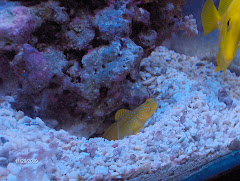
Guess what it is the Pistol Shrimp, the Yellow Watchman Gobies den mate !

Monday, February 8, 2010

Symbiotic Relationships in the Reef

Gobies sometimes form symbiotic relationships with other species. Some goby species live in symbiosis with burrowing shrimps. The shrimp maintains a burrow in the sand in which both the shrimp and the goby fish live. The shrimp has poor eyesight compared to the goby, but if it sees or feels the goby suddenly swim into the burrow, it will follow. The goby and shrimp keep in contact with each other, the shrimp using its antennae, and the goby flicking the shrimp with its tail when alarmed. These gobies are thus sometimes known as watchmen or prawn gobies. Each party gains from this relationship: the shrimp gets a warning of approaching danger, and the goby gets a safe home and a place to lay its eggs in.

Corals and Zooanthellae Algae

Although corals can catch small fish and animals such as plankton using stinging cells on their tentacles, these animals obtain most of their nutrients from photosynthetic unicellular algae called zooxanthellae. Consequently, most corals depend on sunlight and grow in clear and shallow water, typically at depths shallower than 60 metres (200 ft). These corals can be major contributors to the physical structure of the coral reefs that develop in tropical waters.

This is why in a reef aquarium with corals, we have to have powerfull lights simulating the Lumens from the sun. This allows the zoanthellae algae to create food for the corals to grow.

ClownFish and Anemone

Clownfish such as the Clown Anemone fish (in my tank) are the only species of fishes that can avoid the potent poison of a sea anemone. There are several theories about how this is accomplished:

The Clown Anemone, hosts only certain type of anemones, the Bubble Tip Anemone is a favorite host for the Clown Anemone fish.

The mucus coating of the fish may be based on sugars rather than proteins. This would mean that anemones fail to recognize the fish as a potential food source and do not fire their nematocysts, or sting organelles.

The coevolution of certain species of clownfish with specific anemone host species and may have acquired an immunity to the nematocysts and toxins of their host anemone.

Blood Red Cleaner Shrimp and Larger Fish

A cleaning station is a location where fish and other marine life congregate to be cleaned.

The cleaning process includes the removal of parasites from the animal's body (both externally and internally), and can be performed by various creatures (including cleaner shrimp and numerous species of cleaner fish, especially wrasses and gobies).

When the fish approaches a cleaning station they will pose in an 'unnatural' way to show the cleaner shrimp that they want to be cleaned and pose no threat, this can be pointing in a strange direction and/or opening the mouth wide. The cleaner shrimp will then eat the parasites directly from the skin of the cleaned fish. It will even swim into the mouth and gills of the fish to be cleaned.

Cleaning stations are often associated with coral features, located either on top of a coral head or in a slot between two outcroppings.

Thursday, February 4, 2010

Pondering Red Carpet Algae in the Refugium

Today, I decided to look at my refugium more closely, I have the refugium on a reverse photo cycle,from the display tank. I have quite a bit of red carpet algae in the fuge, and my Chateomorpha macro algae is struugling to deal with the red algae. I had place a power head in the same chamber as the chaeto, to provide high flow. Does not seemt o have made a difference.

I re-postioned the power head closer to the surface, so that it will aerate the water. I notices a bit of a surface fil, on the water in the fuge. With the powerhead agitating the surface, the film has dissapeared.

Purchased two Fire Gobies last weekend

Well, I took a chance and purchased two fire gobies, to add to the tank, unfortunately, the both decided to carpet surf, overnight, never even last for 24 hours....

Monday, January 18, 2010

Mandarin Goby eats Fish Food today

Great day today, Mandarin goby which normally eats only live copepods, today was eating pellet food. This is a key milestone, as this means the mandarin goby does not have to rely soley on live copepods for nutrition.

Friday, May 22, 2009

Kevin's Reef Journey

Hi I decided to check out this blog idea. As I write I am not even 100 % sure what a blog is yet ?

Anyway, I decided to get into the hobby of Reef Keeping. I think a blog might be a good way to
share my experience and what I have learned setting up a 30 gallon nano reef.

I set my reef up in September 08, converting a fresh water tank that has been in the family since I was 12, almost 34 years. It was once a salt water tank, then aturtle tank for my brother, and finally he gave it back to me. I set up another fresh water tank...but always wanted to get back into salt water...

Well now I am back..This time with live corals and invertabrates.

My 30 Gallon Nano has about 40 ilbs of Fiji live rock and th following inhabitants

Fish

Fire Goby ( Dart Fish)
Six Line Wrasee
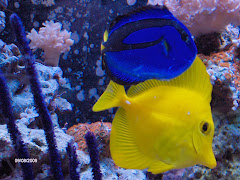
Hawaiin Yellow Tang
Pacific Blue Tang
Yellow Tale Damsel

Invertabrates
Condalactys Anemone
Ten Blue Legged Hermit Crabs
One Horshoe Crab
One mystery Rock Crab
4 Turbo Snails
another mystery snail
2 Cleaner Shrimp

Corals

Branching Tree Coral
Hammer Coral
Frogspawn Coral
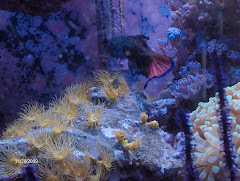
Sun Polyps
Sun Coral ( Tubastrea)
Acropora (SPS)
Autralian War Coral
Platygyrus Open Brain Coral
Pom Pom Xenia
Green Star Polyps
Zoonathids various colors

Equipment

Deltec MCE 600 Skimmer
Nova Extreme 4x39 W T5 HO Fiji Purple, Actinic, 10 K Daylight
10 Gallon Refugium DIY
Battery Back-up DIY
Dosing system Kalkwasser DIY....
Auto Top Off DIY